
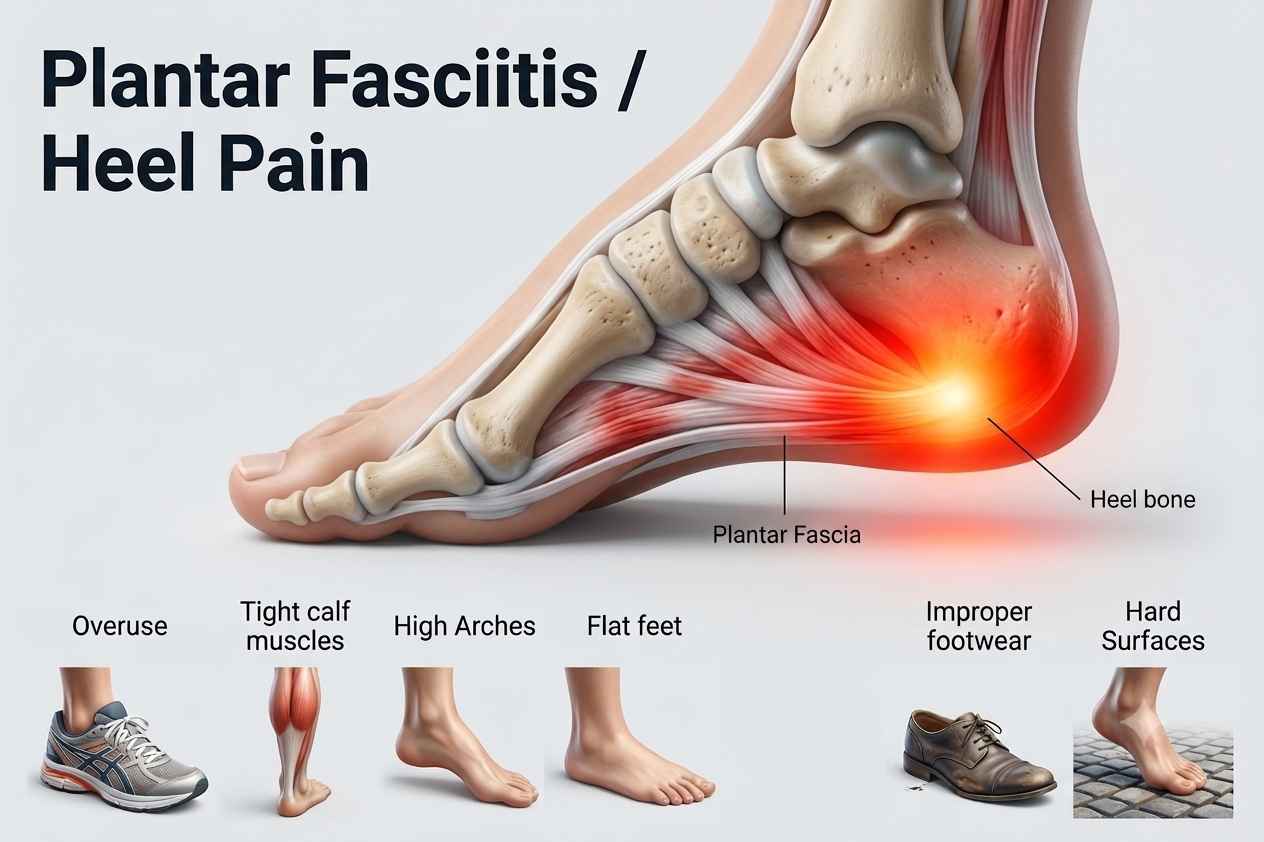
Plantar fasciitis is one of the most common causes of heel pain. It happens when the plantar fascia—a thick band of tissue that runs along the bottom of your foot—becomes irritated or overloaded. This tissue helps support your arch and absorbs impact when you walk or run.
What Does It Feel Like? (Symptoms)
The most common symptoms include:
- Sharp or stabbing pain in the bottom of the heel
- Pain that is usually worse in the morning or after rest
- Discomfort after long periods of standing or walking
- Stiffness in the arch of the foot
- Pain that may improve slightly with movement but returns after activity
A classic sign is the first-step pain in the morning.
Causes and Risk Factors
Plantar fasciitis usually develops from repeated stress or overload rather than a single injury.
Common risk factors include:
- Long periods of standing or walking
- Running, especially on hard surfaces
- Flat feet or high arches
- Tight calf muscles or Achilles tendon
- Poor footwear with inadequate arch support
- Obesity or increased body weight
- Sudden increase in activity level
Diagnosis
1. Clinical Symptoms
Diagnosis is mainly based on history and symptoms, especially:
- heel pain on first steps in the morning
- Pain at the inner bottom heel (medial calcaneal region)
- Pain reproduced with pressure on the plantar fascia
2. Physical Examination
A clinician may find:
- Tenderness at the medial heel
- Tightness in calf muscles (gastrocnemius/soleus)
- Pain with toe extension (stretching the fascia)
- Reduced ankle dorsiflexion
3. Imaging (if needed)
Most cases do not need imaging, but it may be used if symptoms persist or diagnosis is unclear:
Ultrasound (US): shows thickened plantar fascia and inflammation
MRI: used in chronic or complex cases to rule out stress fractures, nerve entrapment, or soft tissue pathology
Management
1. Conservative Care (First Line)
Most patients improve with non-surgical treatment:
-
Rest and avoiding aggravating activities
-
Ice massage to reduce pain and inflammation
-
Proper footwear with arch support or orthotics
-
Night splints (helps reduce morning pain)
2. Activity Modification
-
Reduce running, jumping, and prolonged standing
-
Switch to low-impact exercise (cycling, swimming)
-
Gradual return to activity instead of sudden load increase
3. Physiotherapy & Stretching
Stretching is one of the most effective long-term treatments:
-
Calf stretches (gastrocnemius & soleus)
-
Plantar fascia stretch (pulling toes back gently)
-
Strengthening foot intrinsic muscles
-
Manual therapy and soft tissue release
-
Taping techniques for arch support
4. Shockwave Therapy (ESWT)
Extracorporeal shockwave therapy is considered one of the most effective treatments for chronic plantar fasciitis.
It works by:
-
Stimulating healing response in damaged tissue
-
Improving blood flow
-
Reducing chronic pain sensitivit
It is often used when symptoms last more than 6–12 weeks despite conservative care.
5. Medical Management
If pain persists, medical options may include:
-
Anti-inflammatory medications (short-term use)
-
Corticosteroid injections (for severe cases, used cautiously)
-
Platelet-rich plasma (PRP) injections (in some chronic cases
- Surgery is rarely needed and only considered in long-standing resistant cases.
Summary
Plantar fasciitis is a mechanical overload injury that usually responds well to conservative treatment. Early management with stretching, activity modification, and proper footwear leads to excellent recovery in most cases. Chronic cases may benefit from shockwave therapy or medical interventions.
References (APA Style)
Mayo Clinic. (2023). Plantar fasciitis: Diagnosis and treatment. https://www.mayoclinic.org/diseases-conditions/plantar-fasciitis/diagnosis-treatment/drc-20354851
PubMed. (n.d.). Plantar fasciitis. U.S. National Library of Medicine. https://pubmed.ncbi.nlm.nih.gov/?term=plantar+fasciitis
Koc, T. A., Bise, C. G., Neville, C., Carreira, D., Martin, R. L., & McDonough, C. M. (2023). Heel pain—Plantar fasciitis: Revision 2023 clinical practice guideline. Journal of Orthopaedic & Sports Physical Therapy, 53(12), CPG1–CPG39. https://doi.org/10.2519/jospt.2023.0303
Xiong, Y., Wu, Q., Mi, B., Zhou, W., Liu, Y., Liu, J., Xue, H., Hu, L., Panayi, A. C., & Liu, G. (2019). Comparison of efficacy of shock-wave therapy versus corticosteroids in plantar fasciitis: A meta-analysis of randomized controlled trials. Archives of Orthopaedic and Trauma Surgery, 139(4), 529–536. https://doi.org/10.1007/s00402-018-3071-1
Li, S., Wang, K., Sun, H., Luo, X., Wang, P., Fang, S., Chen, H., & Sun, X. (2018). Clinical effects of extracorporeal shock-wave therapy and ultrasound-guided corticosteroid injections for plantar fasciitis: A meta-analysis of randomized controlled trials. Medicine (Baltimore), 97(50), e13687. https://doi.org/10.1097/MD.0000000000013687
Charles, R., Fang, L., Zhu, R., & Wang, J. (2023). The effectiveness of shockwave therapy on plantar fasciitis and other tendinopathies: A systematic review and meta-analysis. Frontiers in Immunology, 14, 1193835. https://doi.org/10.3389/fimmu.2023.1193835